Report from the Sounds of Advocacy, Language and Liberation Conference

Two founding members of the Guyanese Languages Unit, Tamirand De Lisser and Charlene Wilkinson, attended the conference ‘Sounds of Advocacy, Language and Liberation’ held at the University of the West Indies, Mona Campus, in Jamaica from October 25 to 27.

The event was held in honour of Professor Hubert Devonish and was organised by his past and present students and the staff of the Jamaican Language Unit. It extended over three days and attracted participants from the Caribbean and international community.

All the papers presented covered areas of research, teaching and advocacy inspired by the professor’s work, such as language and the law, language and African diasporic identities, language death, orthography, academic literacies, bilingual education, Bible translation, language and sexuality, language rights, linguistic discrimination, language policy, language in the media, language and Caribbean music, phonetics and phonology, syntax and semantics, indigenous languages and creole linguistics.

The paper by Wilkinson and de Lisser was presented on October 26 in the concluding session of the conference:

Daidrah Smith-Telfer: Wa no ded no dash we: Language revitalisation efforts in Wakapoa – The case of Lokono (Arawak)

Ian Robertson: Losing linguistic competence: Two Berbice Dutch case samples

Audene Henry-Harvey: Linguistic fieldwork in a ritual context: A model

Charlene Wilkinson & Tamirand Nnena De Lisser: Colloquium 2016 and the Emergence of the Guyanese Languages Unit at the University of Guyana

The paper described the activism carried out and the challenges faced in the establishment of the Guyanese Languages Unit (GLU) at the University of Guyana (UG). It outlined the role of the Colloquium 2016 in envisioning the action plan which inspired the proposal for setting up the GLU. It also detailed the works that the unit has been involved in and provided insights into the GLU’s plan of action for mobilising language policy and planning in Guyana.

This conference provided an opportunity for participants to exchange ideas, get feedback on research, open avenues for collaborative work and, in general, broaden their knowledge. Wilkinson and de Lisser said: “We are particularly pleased that we were able to participate. We would like to thank Vice Chancellor Griffith, for funding most of our expenses – airfare and accommodation – and the Faculty of Education and Humanities for funding our conference fees and per diem. We would be delighted to share our presentation with the University of Guyana community and possibly the wider public.”

Text reworked from a report by Charlene Wilkinson and Tamirand de Lisser, ‘Report on the Sounds of Advocacy, Language and Liberation Conference’ dated November 12 2018.

INTERVIEW: Dr De Lisser on preserving Jamaican Creole in Costa Rica + lessons for Guyana

Go to Costa Rica and you’ll most likely expect to speak to people in Spanish or English. But in a city called Limon there is a community of Jamaican descendants who speak what is called Limonese Creole – a dialect of Jamaican Creole. 

Dr Tamirand de Lisser, a member of the Guyanese Languages Unit (GLU) and a linguistics lecturer at the University of Guyana, visited Costa Rica in August 2018 for the 22nd Biennial Conference of the Society of Caribbean Linguistics (SCL), held in collaboration with the Society for Pidgin and Creole Languages (SPCL) at the Universidad Nacional de Costa Rica (UNA) in Limon and Heredia.

Herself Jamaican by heritage, Dr de Lisser shares some of her experiences and explains how what she discovered could help influence the work of the GLU in Guyana…

How did the opportunity to visit Limon come about? Had you heard of them before you went?
The visit to Limon was organised as this was a designated host site of the conference. Unfortunately I had no idea that the people of Limon spoke a language called Limonese Creole, which is a dialect of Jamaican Creole. If I had known I could have prepared beforehand, which would have included taking copies of my books for the community. It’s also unfortunate as this is my area of interest and I had no idea that it existed. But so it is, you live and you learn… no regrets!

Tell us a bit about this community i.e. how they came to be there.
Jamaican migrant workers went to Limon to work on the railways and banana plantations and managed to maintain their language.  

IMG-20180829-WA0009
Courtesy Dr De Lisser

From a linguistic perspective, what was the most exciting part about the visit?
The realisation that this community existed and that linguists at the UNA are moving forward to develop and give status to the language e.g. establishing a writing system and alphabet, working on descriptive grammars, promoting positive attitudes towards preservation of the language etc.

What linguistic challenges (if any) are they still dealing with in the community? 
The linguistic challenges they are facing are similar to those of many Caribbean communities e.g.
– Negative attitudes towards the language, primarily among the younger generations
– Restricted domains of use (mainly at home among families and friends)
– Suppressing the use of the language in schools/education in general
– Non-recognition of the language as a language by the government

IMG-20180829-WA0006
Courtesy Dr De Lisser

How does the visit relate to your work in Guyana/Jamaica and with the Guyana Languages Unit?
The visit is very relevant to my work and research interests in Guyana and Jamaica, and in particular the works to be carried out by the Guyanese Languages Unit. As the challenges faced by the Limonese-speaking community are similar to those faced in Guyana, the GLU can use this as an example and implement similar procedures and mechanisms for uplifting the status of the Guyanese Creole language. We could partner and collaborate with the linguists at UNA on various research initiatives for the  holistic development of Caribbean Creoles.

Do you plan to keep in contact with the community, visit again or follow up in any way? 
I plan to keep in contact with the community primarily via the linguists at UNA. Collaborating on linguistic research with this community is definitely a priority for me. I would love to visit again, and to follow up on the progress of the linguistic developments of the community. I would also like to make a gift available to the community in the form of my translations – Di Likl Prins and Alis Advencha in a Wandalan, which are written in Jamaican Creole but to which they will be able to relate.

FOS KLAAS GRADUATION SPEECH 2018

This address was made by the coordinator of Fos Klaas, Janice Imhoff, at the inaugural graduation ceremony for the group, which aims to promote the usage of Guyanese Creole in writing and society more widely.

On an evening resembling this one, in 2017, the University of Guyana created history with its first-ever course titled An Introduction to Writing Guyanese Creole. Its criteria for selection were a basic primary education. I liked that! It meant anyone just knowing to read and write could walk through the university door. On the last day of class, Tiicha Charlene suggested we form a group. And so, UG fos Kriiyoliiz kors gave birth to a baby we called Fos Klaas: Guyanese Creolese Advocates.

This however was no ordinary baby. It embodied 14 spirits representing the 14 students who were eager to transfer all we learnt to the rest of our beloved Guyana. Yours truly is the coordinator for this first year and we will be rotating this leadership. So, here I stand, to bring you greetings and to warmly thank the University of Guyana, especially our three teachers – Charlene Wilkinson, Dr. Tamirand De Lisser, and Dhanaiswary Jaganauth – for making our birth equally historic… Awi diiz jomp, plee skuul, lil ABC, big ABC, fos standard an awi miit aal di wee to yuuniivorsitii, an tonait, awi iz fo get wi sorfitiikeet dem. Tangk yu a-plenti.

Ladies and gentlemen! This baby is still growing. We are still being nurtured by our “parents”, each bringing their unique growing-food to help us through the creeping stage. Each “parent” is helping us to develop firm walking legs, so that while we have many stumbles and falls, we will be able to get up and continue to acquire skills, and so become responsible Guyanese Creolese advocates.

Fos Klaas, like all babies, has a mind of its own. If you don’t believe a baby has a mind and knows what she or he wants, think again. Put down a baby who wants to remain cuddled, or try to pick up a toddler who has found the glory of walking… iz sheer woriiz.

So, Fos Klaas has many plans and dividing them into short and long term may not be the ideal thing. For example, mastering writing in the Guyanese Raitin Sistem, perfecting the art of transcription and translation from English to Creolese, and vice versa, all start as short-term plans but will continue well into the long term. Also, acquiring data collection skills will start in the short term and continue into our long existence.

What we know is that through both our long and short-term plans, we will be challenging some misconceptions about Guyanese Creolese. I will briefly mention three.

First misconception: that the Creolese language is bad English in action, and it is a poor man’s play thing. No such thing! Bad English is bad English! Don’t use it to write Creolese. Guyanese Creolese, developed by our ancestors, has structure.

Second misconception: teaching the Guyanese Writing System will confuse school children who already have trouble learning to “speak properly”. That, ladies and gentlemen, means speaking the English language correctly. Maybe, the real question to ask is: why did the children have difficulty in the first place!

Third misconception: that the writing system is meant to regularize the different varieties of Guyanese Creoles into one standard Creole. Let us pause here… the Guyanese Writing System will do no such thing. It has no such intention. So whether you speak the Creolese of the African villages, or of the sugar estates, or of the urban working class, or whichever type of Creolese you speak, all the writing system will do is help you write it just the way you speak it. So if for the English word ‘we’ you say ‘wii’, ‘awii’ or ‘abii’, you will write it likewise.

One of our definite long-term plans is to, one day soon, gallop enough running speed so we can lift off and fly. To where are we flying? To meet with other groups, like the already established Informal Working Group, and the soon to be established Guyanese Languages Unit. Together we hope to advocate for the Creolese language to become an official language, right alongside the English language, not in front of it (even though madam chairperson that mightn’t be a bad idea!), but definitely not behind it – where it is now and where it is not being taken seriously. We want it accepted as a language with equal respect.

Gone must be the days when those who speak Creolese hear their mother tongue ONLY through the telecommunication giants who use their language in advertisements to enrich themselves. Gone must be the days when their mother tongue is heard on the drama stage at the National Cultural Centre for actors to receive awards predominantly for cheap melodramas or slapstick comedies. And gone must be the days when the only time politicians seem to find the mother tongue useful is when they seek electoral votes. Those who speak ONLY Creolese must have their voices heard and their writings read and accepted in our legal system, our education system and in our health system. “Wa gud fo di guus mos gud fo di gyanda, ya!”

In closing, may I ask you to imagine this: Students about to take an examination – for example, the one we once called Common Entrance. Imagine the invigilator saying, “Raise your hand if you want to do this examination in the English language… And raise your hand if you want to do this examination in Guyanese Creolese”. And then she concludes, “All those who can do this examination in either language say, yes!”

Yes! This we must accomplish…. in my lifetime and in yours.

[NB: This is an edited version of a previously published post.]

CREOLESE LANGUAGE ACTIVISTS FORM ‘FOS KLAAS’ GROUP

gaiyniizalfabet6

By Janice Imhoff, Coordinator, Fos Klaas

Very high energies were released when the University of Guyana (UG) held its course: Introduction to Writing in Guyanese Creole. This made history: one, because it was the first of its kind after more than a half century of UG’s existence; and two, it must be considered among the firsts of all other sincere attempts to build upon a post-emancipation creation.

Those energies led a group of participants to form Fos Klaas (First Class). This is not yet the definitive name; others, such as Creolese Language Activists, either as an extension or a replacement, are being considered. The group’s philosophy and its main objectives have not been finalised. Fos Klaas has 13 members: 9 females and 4 males with ages ranging from the 20s to 70s. Our three Creolese teachers – Charlene Wilkinson, Dhanaiswary Jaganauth and Dr. Tamir De Lisser – are ex officio members. We boast inclusivity! We reflect the diversity of our Guyanese heritage by way of race/ethnicity, geographic location, occupation and more. Our visually challenged participant used Braille to write Creolese!

So, what are some of Fos Klaas’s plans? For this quarter, we’re heading to Parika for our first data-collecting exercise. This was organised by one member, Robert Samaroo. Next is a trip to University of Guyana’s Berbice Campus, Tain. There we will meet and collaborate with other Creolese-speaking enthusiasts. Finally, in 2018, we’ll publish a booklet titled Why a Guyanese Writing System? and develop a working relationship with the Informal Working Group for Language Policy at UG.

These combined efforts are meant to agitate for a Guyana language policy, the pillars of which must be the acceptance of Creolese as an official language, and the introduction of multilingualism alongside English Language into our education, legal and social systems, throughout the Guyanese community.

Fos Klass is currently open only to members of the Introduction to Writing in Guyanese Creole course, but may open up in future. Sign up to our newsletter for more updates.

CREOLESE OR GUYANESE?

Some of us refer to our language as Creolese.  Others have been using the name Guyanese. Both refer to the same language. Which do you prefer?

Guyanese (or Creolese) is no different from any other language. It has rules just like any other. If you speak Guyanese, you can tell right away whether a sentence is Guyanese or not.

See if you can pick out the grammatical Guyanese sentences from this list:

  1. Meemee de a bakdaam                  (‘May-May is at the backdam’)
  2. Joo de wan brait pikni                   (‘Joe is a bright child’)
  3. Dem a plee krikit                                (‘They are playing cricket’)
  4. Meemee wan tiicha now               (May-May is a teacher now’)
  5. Joo bai som buk dem                     (‘Joe has bought some books’)
  6. Di bokit wash                                      (‘The bucket has been washed’)

You may not know it, but you know the rules of your language. Every human being knows the rules of his/her language. No one has to teach them. This doesn’t mean that they can explain the rules. That is the job of someone trained to write grammars. So, did you pick numbers 1, 3, and 6 to be grammatically Guyanese?

The grammar of Guyanese is different from that of English in many ways. But the words are different too. If I say that you’re disgusting, I don’t mean that you repulse me. We have special  sayings too. Let’s say I hear a song and it reminded me of something you said. I might say, “Mi main jos ron pan yu.” The man talking English would say, “You just crossed my mind.”

Creolese/Guyanese was created by enslaved Africans working on the plantations. The indentured labourers who came later learned this language from the Africans and added words from their own languages. But they did not change the grammar very much, if at all.

Many of the words that came from India are still in use today, but these are often not known by the general public. For many Indo-Guyanese, however, words are all they remember of their ancestral language. They do not know its grammar.

Let’s learn about each other’s language and culture. Let’s learn about our own. There is much to celebrate about who we are.


Further reading

The Linguistic Legacy of Indian-Guyanese

A note about de (deh) in Guyanese

There are two words with the pronunciation ‘de’. These are two homophones: two words with the same sound but different meanings and/or functions.

  1. de is an adverb (or a pro-adverb) meaning English ‘there’
  2. de is a verb indicating location or existence.

Pro-adverb de can be used in place of a locative phrase

  •  Di pikni sidong pan di bed -> Di pikni sidong de
  • ‘The child sits on the bed -> The child sits there’
  • Mi lef mi buk a hous -> Mi lef mi buk de
  • ‘I left my book at home -> I left my book there’

The verb de  conveys both locative and existential meanings. These two meanings are inter-related:  if something is located somewhere, it exists in that location; if it exists, it is located in the world.

  • Di goot dem de a rood
  • ‘The goats are on the road’
  • Piita de wid i fren dem
  • ‘Peter is with his friends’
  • Wan chikin haak de pan di hous tap
  • ‘A chicken hawk is on top of the roof’
  • Awi de ya
  • ‘We are here’

The combination of de + wid can be ambiguous: it can mean any of the following and only the context (including our knowledge of how the world works) will allow us to decide which interpretation is the appropriate one.

  1. X is in the company of Y
  2. X is associated with Y for work-related reasons
  3. X and Y are in a love affair (possibly sexual, possibly living together). A particular type of relationship exists between them.
  • Di pikni de wid i muma
  • ‘The child is with his/her mother’
  • (Context will indicate whether this means ‘The child lives with mother (not with father or someone else)’ or whether it means ‘The child is merely at some place where the mother is right now (e.g. shopping)’)
  • Piita de wid Anii
  • ‘Peter is with Annie’
  • (Context will determine the nature of the association.  Could be a love affair; could be merely a location or even a business association)

In the next example, no such ambiguity exists. The speaker is asserting that the parties are indeed having a love affair.

  • Di tuu a dem de
  • ‘The two of them are in an amorous (non-platonic) relationship’

The next two examples illustrate an existential meaning even more clearly.

  • No moni no de
  • ‘There is no money’
  • (How yu du?) Mi de
  • (How are you?) ‘I’m okay’ (A non-committal response. NB: A Jamaican reply would be Mi de ya ‘I’m here’)

Finally, de can combine with a verb in progressive aspect.

  • Mi de a iit
  • ‘I am in the act of (process of) eating’

The verb ‘de’ and the pro-adverb ‘de’ can both appear in the same sentence.

  • Mi muma hous de rait oova di rood-> Mi muma hous de rait oova de
  • ‘My mother’s house is right across the road’ -> ‘My mother’s house is right over there’
  • Mi muma hous de rait de (rait de-so)
  • ‘My mother’s house is right there
  • Mi muma hous de de
  • ‘My mother’s house is there

Note: It is not accurate to say that de de  (as in the last example above) is a more intense version of de. In this example, de de is a combination of the verb followed by the adverb.

On occasion, however, some speakers might create sentences such as, “i de-de de” as a joke (or word play). The intent is usually to poke fun at the language but it may also be interpreted as an intensifier. In this case, they have doubled the verb de-de.

LECTURE / The last, last Berbice Dutch speaker

On 20 June, Professor Ian Robertson gave a fascinating lecture at the National Library on Berbice Dutch, a language he discovered in the 1970s along the Berbice River (pictured above, image credit Jamaican Languages Unit / caribbeanlanguages.org.jm).

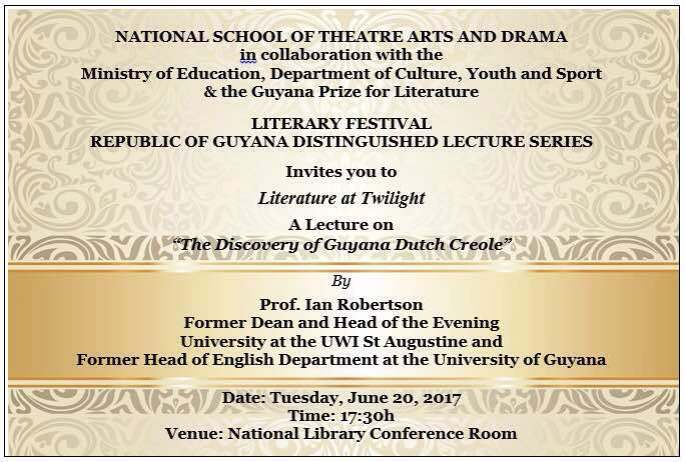
In ‘The Discovery of Guyana Dutch Creole’, the former dean of the Faculty of Humanities & Education at UWI St. Augustine – and a member of the Informal Working Group for Language Policy at the University of Guyana – took the audience on a journey through history and language.

Lit At Twilight invite

Professor Robertson explained that at least two Creole languages with a largely Dutch-derived lexicon developed in Guyana during the period of Dutch control. One of these languages, Skepi Dutch (Iskepie referring to Essequibo), was already extinct by the time he started his research.

We learned about the last-known speaker of Berbice Dutch Creole, Bertha Bell (pictured below)… who turned out not to be the last. And then the last, last speaker, Princess Sauers, who was born at Dubulay on the Berbice river – the same spot where Abraham van Peere, the leader of the Dutch settlers in 1627, established his plantation, Peereboom. Princess Sauers sadly passed away in March 2015 – just one month shy of her 99th birthday.

11709506_880064132031147_2278444167941208700_n
The ‘last’ but not the ‘last, last’ speaker of Berbice Dutch, Bertha Bell.

Professor Robertson, through his interviews with the last speakers (watch an interview with Bertha Bell), has managed to pick up the language. But those same speakers did not pass the knowledge on to their families or in their communities. Attempts to find living speakers along the Berbice and Essequibo rivers have not proved fruitful.

Just some of the interesting nuggets of info shared were that Guyana’s slave rebellion leader Cuffy/Kofi would probably have spoken the language, many core words in the lexicon can be traced back to a West African linguistic group known as eastern Ijo, and that the Arawak (Amerindian) words found tend to refer to nature – unsurprising given that they were there already and would have named the landscape.

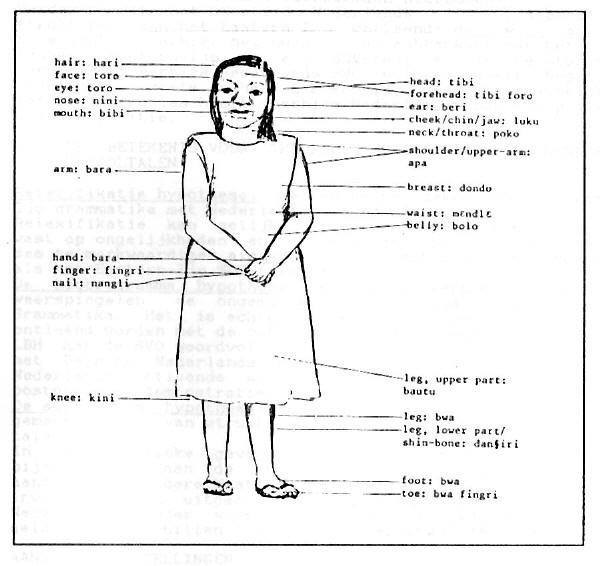
11242337_880064238697803_498351661992375013_nExplaining the second point further, Professor Robertson says: “The language contained more than ten times the number of West African derived forms that could be found in any Caribbean Creole language. All the basic words for body parts and the more central functions like speak, walk, drink, run cold be traced directly to this West African language group. No other Creole language of the Caribbean contains such a high percentage of African derived forms.”

“The presence of so many words from One West African group also suggests that these were the earliest group of West Africans brought to Berbice. The presence of the language provides a window into the early history of Berbice, for which no early documents have been unearthed.”

You can find out more about Guyana Dutch Creole by following the links below. Please comment if you have any information you think would be of interest to other readers, or any personal stories concerning Dutch Creole in Guyana.

> Berbice Dutch Creole definition: https://www.mona.uwi.edu/dllp/jlu/ciel/pages/berbicedutch.htm

> Berbice Dutch article about Robertson’s work (in Dutch) http://nederl.blogspot.nl/2015/07/berbice-dutch-stervende-maar-in-leven.html#more

> Berbice Dutch Officially Extinct, RNW (in English): https://www.rnw.org/archive/berbice-dutch-officially-extinct (NB. This article prematurely reports the death of Berbice Dutch, as another speaker was subsequently found).