

This first awards ceremony of the Guyanese Languages Unit is our expression of gratitude to the team of translators who willingly volunteered their precious skills during the COVID-19 pandemic.
Clip from lecture at University of Guyana by Professor Hubert Devonish, Department of Language, Linguistics & Philosophy, University of the West Indies, Mona: ‘Caribbean Languages as International Language of Popular Music? Reggae, Dancehall and Other Genres’.
Three clips from Writing Creolese the Creolese Way. The session was led by Charlene Wilkinson, a lecturer in the Department of Languages and Cultural Studies at the University of Guyana.
Mother-tongue-based education
The United Nations has finally accepted that every child has the right to be educated in his or her home language. Now, after centuries of trying to erase the languages of some speech communities within their borders, some countries are now reversing their policies. After witnessing the failure of past policies, many former colonies have already been exploring ways of implementing “mother tongue-based education” and sharing their insights on how to make it work.
http://unesdoc.unesco.org/images/0017/001787/178702e.pdf (Home language and education in the developing world)
http://www0.sun.ac.za/taalsentrum/assets/files/ML%20Afr%20Lang%20&%20Cost.pdf (Why & how Africa should invest in multilingual education)
What are Language rights?
As human beings, we use language to do a variety of things on a daily basis. Try to come up with a list of all the purposes for which you use language in one day. The list below could be a start.
Now imagine a situation in which we’re all allowed to use our home language to do all those everyday things. That demonstrate the ideal example of what we mean by language rights.
Nations that try to respect the language rights of their people, do so by first identifying the language communities within their nation. A rough definition of a language community is a group of people who speak a common language and want to be identified as such. In the case of Guyana, this would mean that speakers of Creolese (Guyanese) would make up one speech community. Speakers of each of the different Amerindian languages would represent different speech communities. And speakers of English will form another speech community.
Each speech community will have the same language rights; the language of each such community will be given equal treatment. This means that Creolese and each of the Amerindian languages will be treated just like English is now treated. Each group will be able to use its language to conduct its everyday affairs.
In Guyana at this moment, only the language community that speaks English enjoys all the language rights. To extend these rights to all, it would require that we provide what is necessary to allow this to happen. For example, documents will have to be written in each of the languages, education will be offered in each of the languages, and materials and facilities will be provided so that each community can broadcast in its own language.
The European Charter for regional and minority languages is one document that details the rights which it recommends that member governments give to the minority groups within their countries.
http://conventions.coe.int/Treaty/en/Treaties/Html/148.htm (Council of Europe: European charter for regional & minority languages)
===000=====

TBC
MARCH 2016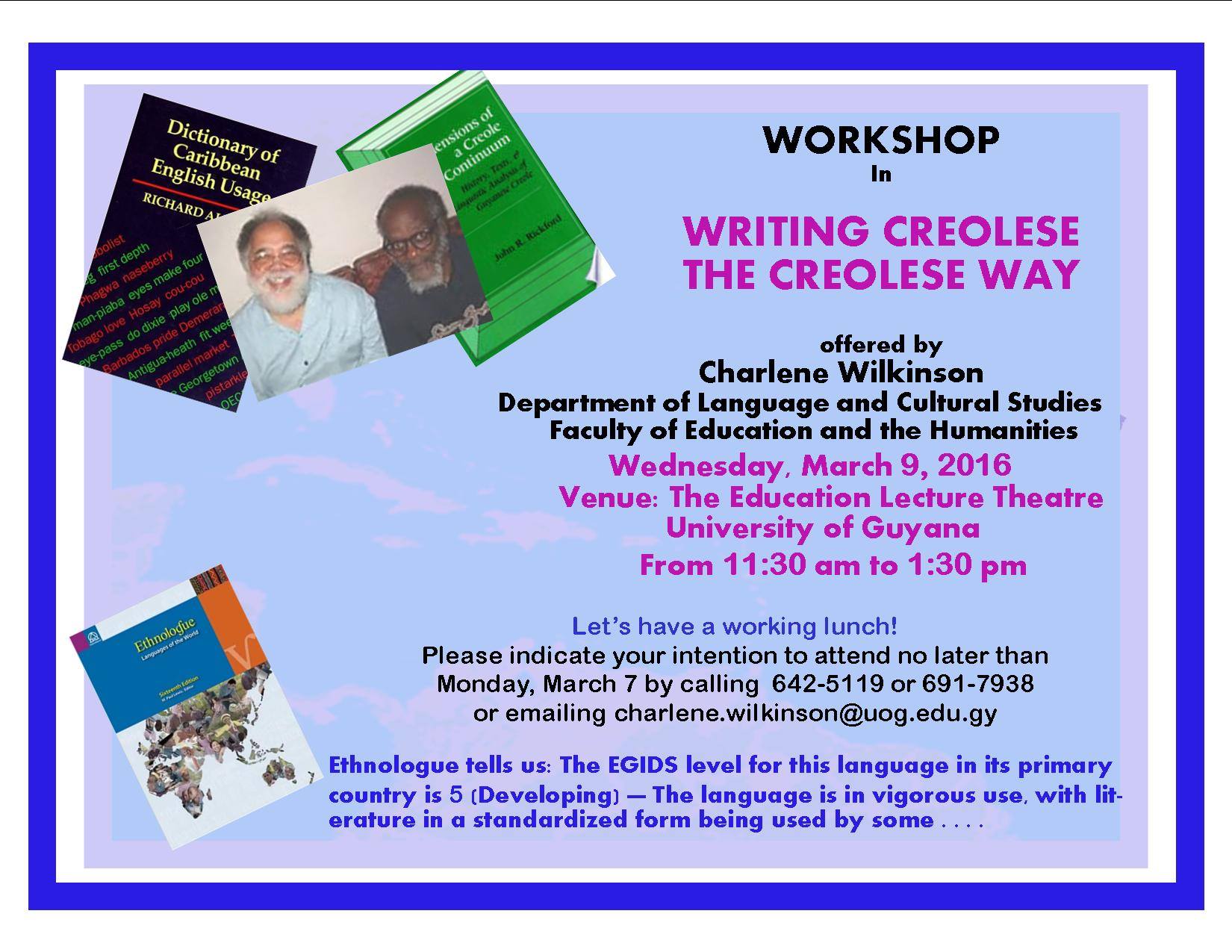 In pictures: Attendees of the first Creole Writing Workshop, March 2016, at the University of Guyana
 The Guyanese Languages Unit